Build your mental health "workforce" from the people youth already trust.
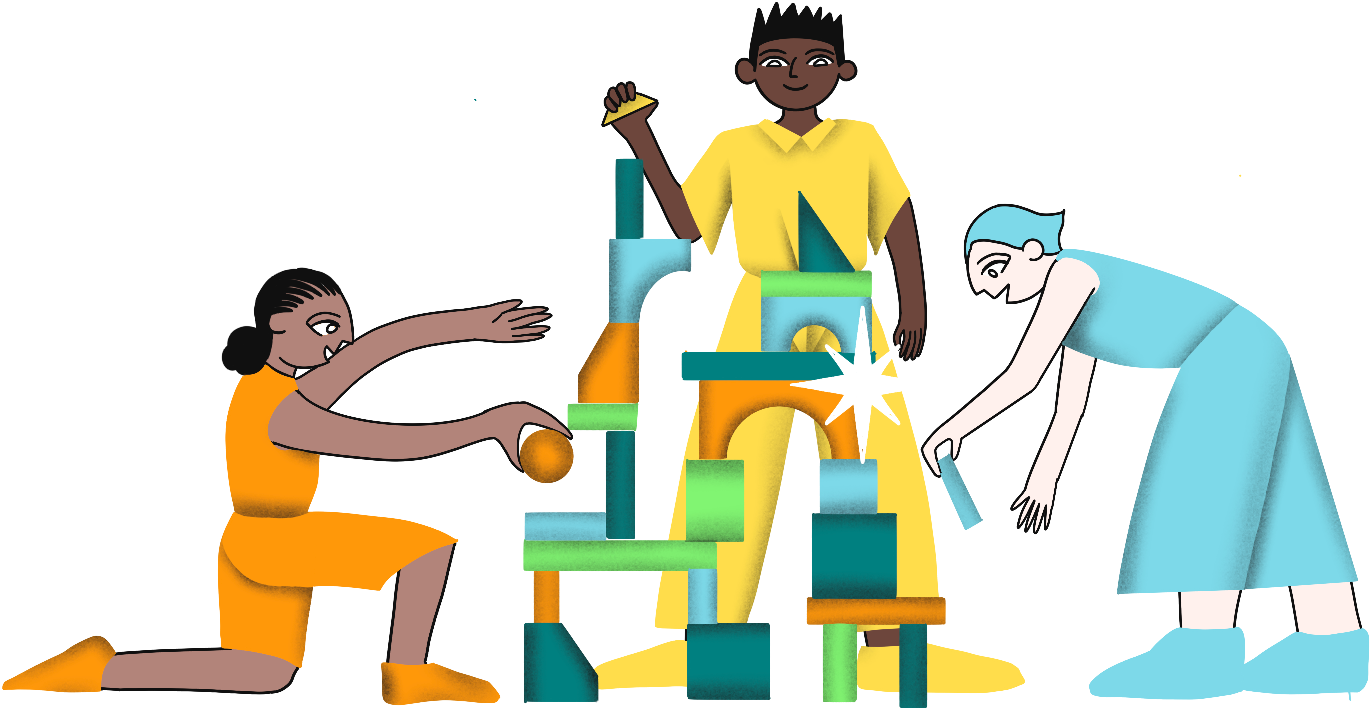
The people who are best positioned to support young people's mental wellbeing are often already in their lives. Coaches, teachers, youth leaders, and local artists who are rooted in the same communities as the young people they work with can hold safe spaces and introduce simple, practical tools in settings where young people already feel comfortable. What these programs do is equip those people with the skills to do that work intentionally.
What this insight means in practice
Across the organizations interviewed for this project, a consistent pattern emerged: when programs embed mental health skills into the work of community-rooted adults and peers, young people engage more readily and outcomes improve. The people delivering the support are already present in the community and already trusted. What changes is that they are given specific skills to notice when a young person is struggling, to respond appropriately, and to introduce tools that help.
Anisha Chablani-Medley, managing director of the Roca Impact Institute, describes how this plays out at ground level. At Roca, which works with young people aged 16–24 who are victims or perpetrators of violence in Massachusetts, the skills workers are trained in aren't delivered in offices or group sessions. "The main modality is through the relationship,” she told us. “It's about equipping the youth worker with the skills so that they're equipped to use it in real time. A lot of times they're delivering it on a street corner or in the car."
This approach is particularly relevant in low- and middle-income contexts where professional mental health services are scarce or inaccessible. But practitioners interviewed for this project note that its value goes beyond filling a gap in provision. Sarah Jeffery, who leads the health portfolio at Vitol Foundation (a collaborator of the SHM Foundation) and has spent a decade funding community-based mental health work, puts it plainly: "These grassroots community-based initiatives are the only ones that are going to work for some aspects of mental health and well-being at community level because of the depth of their reach, understanding, and trust," she said. "They're the only ones who are accepted by and can reach the people that need support."
Who makes up this workforce:
The community workforce described across these interviews includes a range of roles:
Sports coaches
Sports coaches recruited from the same neighborhoods as the young people they serve. At Reclaim Childhood, coaches are responsible not only for training sessions but for picking girls up from home, maintaining communication with parents, and sustaining continuous relationships over years. At Waves for Change, coaches are themselves 18–25 years old and often grew up in the same communities as participants.
Artists
Local artists identified and trained to use creative arts as a facilitation tool. In Cox's Bazar, Bangladesh, Artolution's artists are all from the Rohingya community, chosen specifically because they understand the cultural context, speak the language, and have lived through the same experiences as the participants.
Teachers, caregivers, and community leaders
Teachers, caregivers, and community leaders trained in trauma-informed approaches and basic mental health skills. In rural Uganda, where no professional mental health services exist, Healing Together trains parents, teachers, grandmothers, elders, and widowed women side by side, so that an entire community develops shared language and practice around trauma and healing.
Frontline program facilitators
Frontline program facilitators trained in Psychological First Aid—a structured approach to noticing distress, listening actively, and linking young people to appropriate support—who work within school-based programs and are drawn from similar backgrounds to the young people they serve.

Why community rootedness matters
Several practitioners describe the mechanism behind why community-rooted workers are more effective in these contexts, and the explanation goes deeper than language or cultural familiarity.
Deborah Diedericks of EMpower illustrates this through an example from South Africa:
A message of hope or possibility carries a different weight depending on who delivers it. When someone who grew up in the same community, navigated the same systems, and built a life the young people around them can recognize speaks about what is possible, that message tends to carry more weight.
At Roca, this principle shapes the organization's entire hiring model. Olga Romero, who came through Roca as a young person before later joining as a youth worker and eventually leading its Young Women's Program, describes what this makes possible—and what it rules out. "I think a lot of the staff that come here that work at Roca, it doesn't matter eastern Mass, western Mass, they have either come through Roca themselves or have lived experience that allows them to show up with the Roca values—which is transformation, empathy, honesty, safety—because we have that lived experience. It's something that I don't think can be taught." She puts it more simply elsewhere in the conversation: "You can't teach what you don't know."
Rima Yacoub of Reclaim Childhood describes a parallel lesson at the organizational level. After an early expansion into a new area, Reclaim Childhood found that operational success depended on building deep community relationships before entering—ahead of identifying a suitable location. "It turned out we needed a more solid base, more research on areas and people, and probably more trial and error. From our first expansion, we learned a lot, and we started focusing more on building community partnerships before we expanded into that area." Subsequent expansions, shaped by that lesson, went more smoothly.
Marine Burdel of Artolution describes the same principle as foundational to their artist selection process: "They know their context. They know what people are going through. Most of our artists are refugees themselves or have been affected by violence or migrations. Most of our artists, our staff and our teams are people who we consider direct beneficiaries."
What these workers are equipped to do
A recurring theme across the interviews is the importance of being explicit about what community workers are and are not being asked to do. Practitioners consistently describe a bounded, specific set of skills.
The most commonly described framework is some version of "look, listen, link"—a Psychological First Aid structure in which workers learn to observe changes in behavior or affect, create the conditions for a young person to be heard, and connect them to appropriate support when something beyond their scope arises.
Lana Rolfe of School of Hard Knocks South Africa describes how this framework shapes their frontline training:
Alongside this, programs teach a small set of practical techniques that community workers can embed into regular programming—breathing exercises, check-ins, grounding activities—which do not require clinical training to deliver but have meaningful effects on young people's nervous system regulation and sense of safety.
FAQ
If community workers aren't therapists, where does clinical support fit?
Practitioners interviewed for this project are consistent on this point: the community workforce is not intended to replace clinical care. Its role is upstream—promotion and prevention rather than diagnosis and treatment. When a young person's needs exceed what a community worker is equipped to handle, the "link" component of the look-listen-link framework routes them to appropriate support.
In practice, establishing those referral pathways is one of the most difficult parts of implementing this model. Diedericks describes it as "by far the most complicated" of the three components of mental health first aid training, noting that in many countries, referral systems exist in theory but are difficult to access in practice—phone numbers that don't work, organizations that don't respond. Building functional referral infrastructure requires ongoing investment and is often still a work in progress for organizations doing this work.
Rolfe of School of Hard Knocks South Africa describes a related tension: the risk of escalating disclosures through formal channels too quickly, which can damage the trust that makes disclosure possible in the first place. Her organization maintains a tiered system in which frontline workers escalate to a team lead before anything reaches the safeguarding team, specifically to preserve the relationship between the young person and the worker they trust.
Protecting the workforce
One dimension of this model that practitioners flag as frequently overlooked is the wellbeing of the community workers themselves. These individuals often come from the same communities, carry the same exposures to adversity, and are regularly in proximity to disclosures of abuse, violence, and trauma. Several organizations interviewed for this project have built explicit structures to address this.
FAQ
How do you maintain quality and consistency when the workforce is distributed and non-professional
Organizations interviewed for this project use several mechanisms. Waves for Change conducts curriculum training with coaches every week, including scenario-based skill-building through a program called EQUIP. School of Hard Knocks South Africa requires session reports, photos, and pre/post data from facilitators before releasing the second half of their payment. Reclaim Childhood conducts in-depth interviews with coaches before expanding to new areas, having learned from an earlier expansion that insufficient vetting undermined program quality. Healing Together uses a standardized curriculum—including a Healing Advocacy Training workbook and an emotional first aid guide available in 27 languages—to ensure consistency across trainers and contexts.
The common thread is that training is not a one-time event. It is ongoing, embedded in the regular rhythm of program delivery, and responsive to what is happening in the field.
